

Communications Essential for Keeping a Record-Breaking World Cup Tournament Safe

The 2026 World Cup has officially wrapped up, delivering everything fans anticipated and more. But before the first players even took the pitch, this World Cup tournament was already setting milestones.
The 2026 World Cup was the largest in history, with an expanded field of 48 nations competing and an expanded knock-out round to accommodate the additional competitors. It was also the first World Cup ever to be hosted by not one but THREE nations – with numerous cities across the US, Mexico, and Canada all hosting World Cup matches.

Spectators and soccer fans from every corner of the globe were treated to incredible action and some unexpected upsets. Spectators inside massive stadiums, watch parties, and fan zones gathered outside of stadiums and in cities across the country.
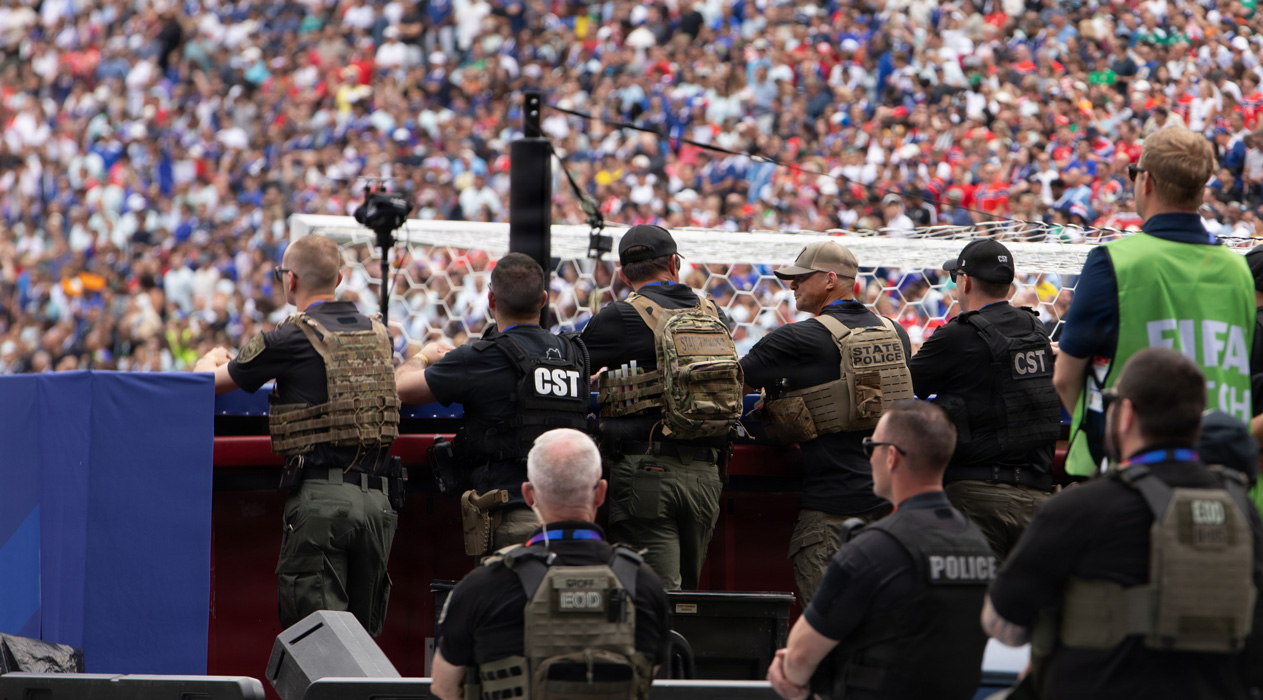
What the fans don‘t typically see is the coordination happening behind the scenes to keep everyone safe. That task is made more difficult by the size and scope of this sprawling spectacle and the sheer number of incredibly passionate people in attendance, many of whom have flown in from their home countries for the event.
Six Super Bowls in one day
Attendance at Super Bowl LX at Levi’s Stadium reached over 70,000 people. World Cup matches have drew similarly large crowds, averaging nearly 65,000 spectators per game. In fact, during the World Cup group stage, three to six Superbowl-sized matches were played each day, which helped FIFA set a new attendance record, when more than 425,000 spectators from over 200 countries attended games.
Crowds of this size place tremendous pressure on the law enforcement and emergency response organizations of each host city. But an event like the World Cup is bigger than the individual cities where the games are being held – the eyes of the world are on each game, and travelers from all around the globe are in attendance.
This is why federal law enforcement and homeland security agencies are also playing a role in the World Cup’s security and emergency response, often collaborating with local organizations and private security companies.
As we take a look back at the FIFA World Cup, it’s important to understand the challenges faced by law enforcement organizations, who are already planning to support the 2028 Summer Olympics.
As a recent ESPN article explained, “…more than 400 law enforcement agencies are working with the federal government and private security firms to secure the stadiums, fan festivals, base camps and hotels for the record 48 teams who will play 78 matches over 39 days in 11 U.S. cities, with another 26 matches in Canada and Mexico.”
Each of the organizations coming together to provide security services for World Cup spectators has its own role to play, and each faces its own challenges in communications, situational awareness, and collaboration.
As we take a look back at the FIFA World Cup, it’s important to understand the challenges faced by law enforcement organizations, who are already planning to support the 2028 Summer Olympics. Lessons learned from major sporting events can enable these organizations to be better prepared and connected for another major event in the United States.
State and local law enforcement: Often working in concert with private security organizations, first responders, and emergency medical professionals, these agencies are the primary force responsible for providing public safety and security services to the World Cup host cities.
However, that’s a big job that involves much more than simply fighting crime, providing emergency health services, and enforcing public safety in a single stadium or facility. Each of the World Cup host cities has events tangential to the games that also require their services. This includes the FIFA Fan Festivals (giant outdoor football experiences and watch parties) and other events that may be held to coincide with the games.
State and local law enforcement are responsible for keeping the peace in environments where national pride and competition often come together in a somewhat turbulent and violent way. For example, watch parties in the San Francisco Bay area and in New York City have turned violent when fans of competing nations clashed over the result.
Traditionally, state and local law enforcement organizations rely on traditional voice radios for communication during operations and during large events. However, voice communications can create challenges in locations filled with tens of thousands of shouting fans. Not only can it be difficult to hear radio communications over the din of a large event, but voice communications also pose problems for situational awareness and sharing location information.
When voice is the primary mode of communication, it can be difficult for a single law enforcement officer to call for backup. In a crowded environment, an officer’s call for help may be drowned out by the noise of the crowd. Even if it is heard, that officer can only share their location by describing nearby landmarks or their surroundings.
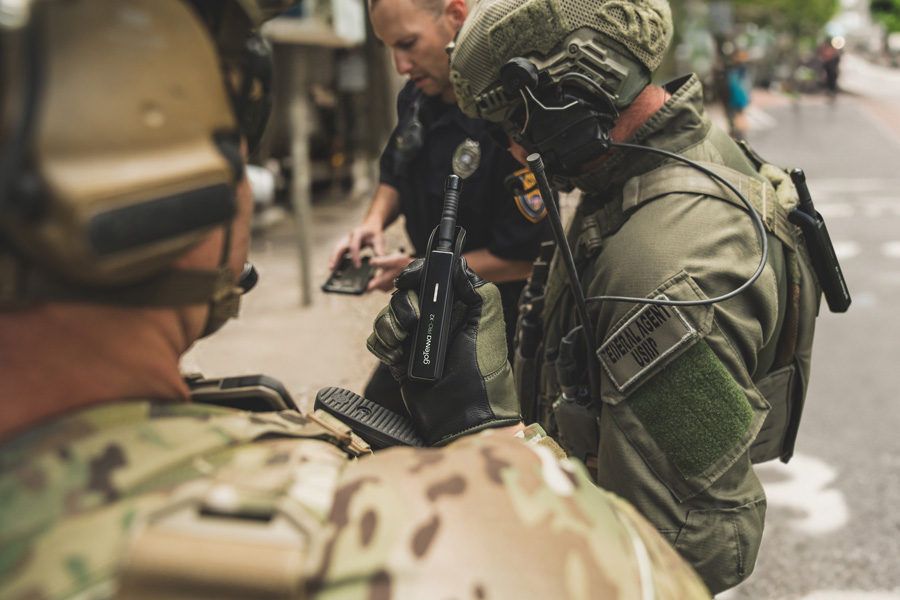
Mobile mesh can eliminate many of these challenges for law enforcement and emergency response organizations. Mobile mesh relays, such as the goTenna EdgeRelay, can be deployed in advance of a major event to provide a wide area of connectivity via an ad hoc mobile mesh network. The interoperable nature of this network would enable each law enforcement officer, private security officer, and emergency medical responder equipped with a mobile mesh radio connected to their personal mobile device to communicate via text and even see one another’s locations on a physical map.
By leveraging mobile mesh networks, state and local law enforcement will have access to an interoperable communications tool that makes it easier to collaborate in crowded, noisy environments. They’ll also have a situational awareness tool that will make it significantly easier to deploy resources where needed and call for assistance when necessary. But state and local law enforcement are not the only organizations operating during the World Cup.
Federal agencies and law enforcement: Given the global nature of the World Cup and ongoing global hostilities, there are always concerns about terrorism at any major sporting event. According to CNN, officials claim that, “…the threat of a lone actor deciding to attack an event or crowds remains the top concern, as people can often plot attacks undetected.”
With concerns about terrorism, human trafficking, and other public safety concerns, the federal government was more actively involved in this year’s World Cup than in a traditional sporting event. When federal agencies collaborate with other organizations, interoperability challenges often arise. That’s because each organization brings its own communications equipment to an operation, and that communications equipment often doesn’t work well together.
When communications equipment fails because of interoperability challenges, many federal, state, and local law enforcement professionals will fall back on cellular communications to fill the void. But that can create its own challenges in crowded environments.
As the United States prepares for the operational challenges that accompany a sporting event of this scale, resilient and interoperable communications should be a central part of the planning process.
When a major sporting event occurs, there is a massive influx of network users all crowded into a handful of concentrated areas. The connectivity requirements of these tens of thousands of individuals can strain local networks. Having three to six of these games happening simultaneously can then stress the larger, national networks of major cellular providers. This is why one publication coined the 2026 World Cup as “The biggest network stress test of 2026.”
Relying on cellular networks to deliver mission-critical communications in these environments poses a risk many federal agencies and law enforcement organizations won’t want to take. Thankfully, this is another area where mobile mesh networking can help.
Mobile mesh networking radios connect to practically any mobile device that law enforcement personnel carry. Once connected, they create an ad hoc network that is inherently interoperable – connecting everyone with a radio, regardless of their device. This makes it easy for personnel from private security companies, state and local law enforcement organizations, federal agencies, and other first responders to begin communicating and interacting immediately. It also provides everyone on the scene with integrated, accurate situational awareness.
Since each radio functions as a receiver and transmitter, there is no single point of failure. If one radio is denied or degraded, the entire mobile mesh network remains connected, making it a resilient and redundant alternative to mobile networks that could become taxed, overloaded, or unavailable in large crowds and during large sporting and cultural events.
In two years the summer Olympics will be bringing millions of visitors back to North America. As the United States prepares for the operational challenges that accompany a sporting event of this scale, resilient and interoperable communications should be a central part of the planning process.
Ensuring that law enforcement, federal agencies, emergency medical services, private security, and event personnel can remain connected—regardless of network conditions—will be critical to maintaining coordination, situational awareness, and effective incident response throughout the event.
The Author




No Comment