
Gaining an ARSOF Advantage with Mobile Mesh Networking

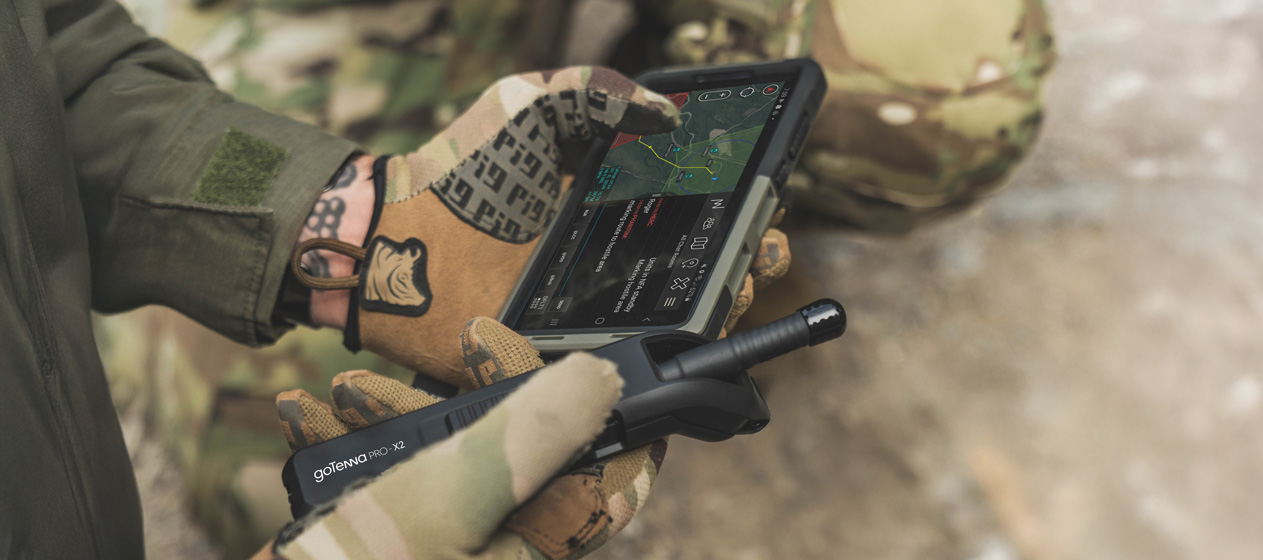
The U.S. military has a broad mission, which often involves working with international coalitions, allies, and partner forces. A key element of working with partner nation forces is the Remote Advise and Assist Virtual Accompany Kit (RAA/VAK).
The RAA/VAK Kit has enabled U.S. military and partner forces for years to increase communications and lethality. As battlefield tactics and technology advance, the U.S. and our partners are constantly adapting to change. RAA/VAK is often used in contested environments and, as a result, will face certain capability challenges in implementing a low-signature, infrastructure-independent method for tracking and communicating with partner forces in real time.
These challenges were explored in depth in a recent U.S. Army Special Warfare Journal article, “Transforming the ‘ARSOF Advantage’ Lines of Effort with Enhanced Mesh Network Technology,” authored by Dr. Daniel Ross. This article was awarded First Place in the Special Operations Center of Excellence (SOCoE) 2025 Writing Competition and provides a deep dive into how integrating mobile mesh networking technologies into the RAA/VAK could better enable America’s Special Forces to partner with coalition forces on the battlefield.
In particular, the article calls for enhancements to the kit by incorporating a low-SWaP-C (Size, Weight, Power, Cost) communications device that is not dependent on other communications infrastructure, such as satellites and cell towers – enabling secure and flexible communications with partner forces. This technology should be simple to use, in order to support easy training and utilization by partner forces.
One of the communications technologies suggested in the article for this particular purpose was mobile mesh networking.
To learn more about the benefits that mobile mesh networking can deliver to America’s Special Operations Forces and why the integration of mobile mesh into RAA/VAK could provide a tactical edge on the battlefield, we sat down with Tim Miller, the Director of Customer Experience at goTenna, the leading provider of mobile mesh networking solutions to the U.S. government and military.

The Last Mile (TLM): What is the current status of RAA/VAK, can you describe what RAA/VAK is and enables?
Tim Miller: In order to describe where we are, it’s important to discuss how we got here. We’re almost 25 years removed from the terrorist attacks on 9/11. One of the major failures that was uncovered in the wake of 9/11 was the lack of information sharing and interoperability across the U.S. government, and that was just on the U.S.-side of the house.
Unfortunately, nearly 25 years later, we still seem to face interoperability issues. This is especially true when you bring in partner forces from a variety of nations, cultures, and countries, many of whom speak different languages. Interoperability becomes much more complex and critical, which is why RAA/VAK is so critical in bridging these gaps.
As you know, Special Operations Forces (SOF) missions have evolved significantly since 9/11, and even more so in the past few years. SOF operators used to be on the front lines with partner forces. However, the gap – both physical and technological – between SOF operators and the coalition forces they support has widened. Today, they primarily serve in a remote advisory and assistance role, helping partner forces from a distance, away from direct engagements.
The RAA/VAK enables special operators to virtually assist and advise partner forces in an overseas environment from a distance, even over the horizon.
Joint goTenna deployment can provide an easy-to-use pathway for secure situational awareness between blue force and green force units. Without this, blue force units can be left in the dark to green force positioning. On objective, this lack of real-time intel can mean life-or-death.
TLM: How could the integration of mobile mesh networking improve the RAA/VAK?
Tim Miller: The partner force in these environments is the eyes and ears for our SOF operators at the front. Partner forces need the ability to pass information back to SOF operators so they can provide timely, relevant counsel and remote assistance. While many technologies could be leveraged for this critical information link, they also have limitations. For example, this can be done with satellite communications or with another terrestrial communications network. However, those networks can often be denied or degraded at the tactical edge.
Diving in a bit deeper, cellular service is not a viable option on most battlefronts – being either compromised or nonexistent. Satellite is an option in some cases, but it has significant limitations, such as latency, failures during poor weather, and issues with fast movement, traversing mountainous terrain, canyons, vegetation, and indoor environments. Terrestrial mesh technologies like goTenna do not have the same limitations.
As you can imagine, these scenarios and conditions are not the exception for our warfighters; they are the rule. This is where our forces and partners operate day in and day out, underscoring the criticality of a solid, reliable communications network.
In that regard, integrating a technology like mobile mesh networking into the RAA/VAK would increase the resiliency of this communications backbone and deliver more assured, “always on” communications. This added robustness to the communications plan enhances the reliability of situational awareness between partner forces and U.S. SOF operators.
TLM: There are five lines of effort needed to enable an ARSOF advantage. Can mobile mesh help advance any of those five lines of effort?
Tim Miller: There are numerous lines of effort that mobile mesh can help advance. In fact, if pressed, I would say that mobile mesh could help with four out of the five, and I think the article does a great job breaking down these lines of effort and how mobile mesh aligns within them.
The first line of effort involves conducting deep and denied area sensing. You can have the best sensors in the world, but if they can’t get data back to the humans that need it, they’re not worth anything. Adding terrestrial mobile mesh to the RAA/VAK provides a resilient, redundant alternative for passing data from sensors on the front lines to SOF operators.
“Not only is goTenna a viable solution, it’s an operationalized, battle-tested technology for warfighters.” –Tim Miller
The following line of effort involves Counter-Command, Control, Communications, Computers, Cyber, Intelligence, Surveillance, Reconnaissance, and Targeting (Counter-C5ISRT). Again, this is an area where moving data over the battlefield in a resilient, redundant way, with a sovereign, terrestrial mesh network, could be beneficial.
The next line of effort involves conducting deep area partner force maneuver. Being physically removed from the partner force operating on the front lines, SOF operators need a redundant communications system that provides the communications and situational awareness capabilities they require. A narrowband, terrestrial mesh network as the backbone of the communications plan provides them with an assured, sovereign network that is not reliant on a third-party system.
The fifth and final line of effort involves enhancing resilience, developing resistance forces, and consolidating gains. I believe that the first three lines of effort that we discussed all play a role in enabling this line of effort, and enhancing resilience is what mobile mesh networks do best.
TLM: What security features and capabilities make a mobile mesh solution like the goTenna Pro X2 a viable solution for SOF teams?
Tim Miller: Not only is goTenna a viable solution, but it’s also an operationalized, battle-tested technology for warfighters. goTenna is already being used operationally in theaters across the globe – from Eastern Europe, to the Pacific, to Africa, and the Middle East.
One of the key drivers of operational forces adopting goTenna is not only ease-of-use, sovereign reliability, and secure encryption, but also its applicability to addressing EW concerns and contested comms environments – on the modern battlefield, against a new generation of peer and near-peer adversaries, we have to think about the RF signature of our forces.
The adversaries we’re facing have incredibly advanced electronic warfare (EW) capabilities and can identify troop locations and movements from the signals they transmit.
“The most significant advantage that mobile mesh would bring to the RAA/VAK would be the ability to expand the edge – not only on the battlefield, but also in disaster response scenarios.” –Tim Miller
In this advanced EW environment, having “noisy” signal transmissions can mean the difference between being located and targeted by the adversary and staying invisible on the battlefield. Mobile mesh utilizes a burst communications profile, making it far more difficult to detect and intercept the signal than with wideband and higher-power comms.
goTenna’s mobile mesh networking solutions transmit for about 70 milliseconds per message on adjustable power from 5 to 0.5 Watts. Compare that to a streaming manpack or MANET radio, and it’s a lot quieter.
TLM: What new functionality or capabilities would SOF teams gain with the integration of these solutions into the RAA/VAK?
Tim Miller: The most significant advantage that mobile mesh would bring to the RAA/VAK would be the ability to expand the edge – not only on the battlefield, but also in disaster response scenarios when infrastructure goes down.
On today’s battlefield, we may have a satellite-connected land vehicle, such as a truck, transporting a number of partner troops. That vehicle would be connected via a satellite network that potentially has seven to eight seconds of lag (when available), which is not ideal, but still offers communications and situational awareness between the SOF operators and the partner troops they’re supporting.
However, as soon as the vehicle is parked and the partner troops dismount, the SOF operators have a problem. The individual partner troops won’t have connectivity; only the vehicle will. The SOF operators will still have communications and situational awareness of the vehicle, but not the troops.
“Adding mobile mesh to RAA/VAK would give SOF operators even more visibility and transparency on the battlefield – enabling them to see at the individual troop level.” –Tim Miller
Mobile mesh eliminates this problem by enabling each individual operator – green force and partner force – to be connected. Each soldier would be deployed with a mobile mesh networking radio, making them a node in a decentralized, ad hoc network. In this case, partner forces would each be able to communicate with the SOF operators advising them. Each of their locations and movements would be known to their advisors.
Domestically, city-wide search-and-rescue operations after a natural disaster often struggle to maintain tracking and communication of Task Force members once they leave the operations center. Everyone has a phone, but it’s virtually useless when infrastructure is down. goTenna is a rapidly deployable technology that is designed to be used interoperably across organizations and mobile platforms.
This is what we mean by “expanding the edge.” Adding mobile mesh to RAA/VAK would give SOF operators even more visibility and transparency on the battlefield – enabling them to see at the individual troop level.
The Author



No Comment