

Rain Technology Solutions and goTenna Revolutionize Medical Response for the DoD

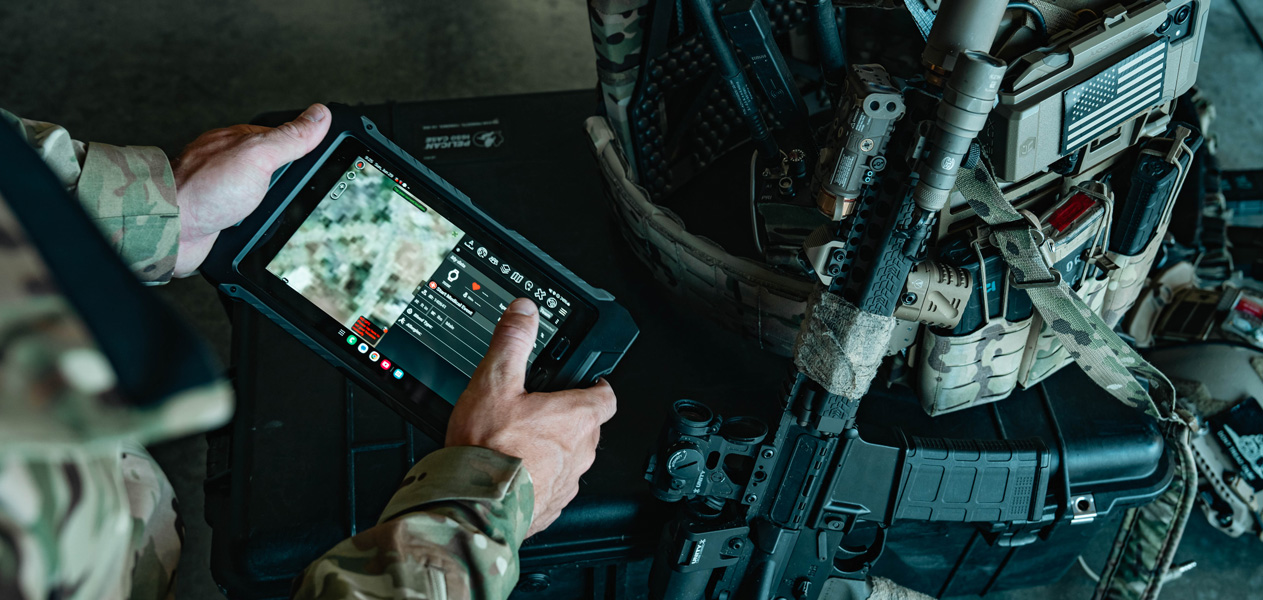
When someone is injured in the field—whether it’s a soldier in combat, a firefighter responding to an active wildland fire, or a Border Patrol Agent on remote terrain—every second counts when giving lifesaving medical aid. But in the chaos of a crisis, reliable communication and accurate medical tracking are often the first things to break down. Critical information gets lost, response times slow down, and lives hang in the balance.
How can life-saving information be communicated when there’s no network, no infrastructure, and no margin for error?
To overcome this challenge, Rain Technology Solutions—a leader in edge-based medical communication software—is partnering with goTenna, a pioneer in mobile mesh networking, to revolutionize how teams maintain situational and medical awareness in the most austere, remote, and network-denied environments.
We recently sat down with Stone Hazlett, Founder and CEO of Rain Technology Solutions, for an inside look at how the company’s partnership with goTenna is transforming real-time medical coordination and decentralized communication for the Department of Defense (DoD).
The Last Mile (TLM): Can you tell our readers a bit about Rain Technology Solutions and its Hail solution?

Stone Hazlett: Rain Technology Solutions is a software development company by trade. We launched in 2019, and our flagship product is HAIL, which stands for Health, Awareness, Intelligence, and Logistics.
HAIL is designed to digitally connect vital signs, medical treatments, DD1380 information, and intervention requests for users operating at the edge. It links those on the ground with command centers and critical care facilities, even beyond line of sight.
Moreover, we’re sensor-agnostic, meaning we partner with best-in-class sensor companies—everything from commercially available consumer-grade wearables like Garmin and Samsung, to clinical-grade devices like mobile ECG monitors or portable ultrasounds. Our platform digitizes all that data in real time, making it shareable across the network.
Right now, a lot of this information is still recorded with analog processes – handwritten notes on casualty cards, or even on the patients themselves.
While I don’t think our technology will eliminate those analog methods, we’ve digitized the processes that are already approved and in use today, such as the DD1380 form used by the DOD and the entire Tactical Combat Casualty Care (TCCC) workflow. We’re also developing the standard for digitally-aided casualty evacuation (DACASEVAC).
In simple terms, our HAIL solution enables operators to request ground or air evacuations digitally over the network, eliminating the need for voice communications.
TLM: Where did the concept for HAIL come from?
Stone Hazlett: The concept for HAIL —and really for Rain Technology Solutions itself—comes from my own background. I was an Air Force Combat Controller, and I got a glimpse into just how chaotic casualty evacuation can be. It’s not just downrange—these challenges exist here domestically and in friendly environments around the world.
“We saw an opportunity to create a solution natively within ATAK, the system that so many in the force are using.” –Stone Hazlett
Care under fire and taking care of people who are injured in the field is incredibly complex and often chaotic. I’ve only seen a small part of that, but medics, operators, and first responders live it every day. Starting Rain Tech was about closing the gaps they face when seconds matter most.
When we first launched the company, we saw an opportunity because ATAK was spreading rapidly across both the DOD and public safety. Consequently, data environments were becoming more available at the edge.
Before that, we were relying on line-of-sight communications and older satellite systems. Then operators started getting their hands on more advanced data radios—like those from goTenna, among others—which expanded what was possible. So, we saw an opportunity to create a solution natively within ATAK, the system that so many in the force were already using.
TLM: What different types of information does HAIL send? How does this improve situational awareness?
Stone Hazlett: HAIL delivers a layer of medical situational awareness that goes far beyond location tracking. Using wearable sensors, it provides real-time health monitoring, even before an injury occurs.
Vital signs such as heart rate, blood pressure, oxygen levels, and exertion are displayed through a simple traffic-light system, allowing medics and commanders to instantly see who needs attention without sifting through raw data. Alerts are then triggered when someone’s condition changes, ensuring no time is wasted.
In addition to live health monitoring, HAIL digitizes the entire medical treatment workflow, such as TCCC protocols and the DD1380 casualty card. This data is instantly shared across the network, giving commanders and care facilities real-time visibility—even beyond line of sight—and eliminating the delays and errors that come with handwritten notes.
Finally, HAIL streamlines casualty evacuations by digitizing the standard 9-line request format for ground or air assets. Evacuation details—like asset type and ETA—are transmitted over the network, removing the need for voice comms and speeding up response times.
“By cutting analog delays and enhancing decision-making, HAIL aims to shrink the “golden hour” and get injured personnel to higher levels of care faster, ultimately increasing survivability when every second counts.” –Stone Hazlett
Essentially, the table is already prepped for personnel in the field to get the care they need, when and where they need it most. By cutting analog delays and enhancing decision-making, HAIL aims to shrink the “golden hour” and get injured personnel to higher levels of care faster, ultimately increasing survivability when every second counts.
TLM: Who could you envision benefiting the most from HAIL? Is this a military solution only, or could it also be used in emergency response, law enforcement, and other areas of government?
Stone Hazlett: There’s an obvious use case within the DoD, which is one of our primary markets. That said, HAIL has applications far beyond that—federal and state law enforcement, municipal police, fire departments, search and rescue teams, wildland firefighters—anyone operating at the edge in potentially dangerous environments can use this.
While our current focus is on the DOD, there are clearly use cases for this technology among federal law enforcement and large, state-level agencies and organizations. For example, anyone operating along the southern border would see immediate value in this product.
We also view this technology as a critical capability for training houses, military or law enforcement academies, and other settings where candidates perform rigorous physical activity. This gives the cadre a much better understanding of the physical information for each candidate, ultimately enhancing performance and awareness for all parties.
As a former operator, I can appreciate the fact that we’re giving units the ability to truly own their comms network and not be beholden to recurring data plan fees. And, of course, users also own their data, which is very important. We often hear end users who love a particular hardware element but won’t use it because they don’t have control over where that data goes or who has access to it. With goTenna, you own the network, and you own the data.
TLM: What technologies, applications, and other solutions are needed for an organization to get started with HAIL?
Stone Hazlett: If you’re an organization starting from scratch with no pre-existing infrastructure, getting set up with HAIL is straightforward. You’d need ATAK, an end-user device, a wearable, and a HAIL license. That’s all it takes to get up and running, even if you’ve never used ATAK before. Of course, this hardware is all commercially available, so there aren’t many hoops to jump through for hardware procurement.
If you’re already an ATAK user, it’s even easier. All you need is the HAIL license. If you already have a compatible wearable—like a Garmin or Samsung watch—you’re essentially ready to go. Our solution requires nothing more than a software download from the Google Play Store.
“Vital signs such as heart rate, blood pressure, oxygen levels, and exertion are displayed through a simple traffic-light system, allowing medics and commanders to instantly see who needs attention without sifting through raw data.” –Stone Hazlett
We’ve also developed the ability to connect certain wearables, like the Samsung Watch 7, directly to a goTenna device. This means you don’t need to provide or carry a smartphone or other device. For some organizations, that can be a big advantage if the cost of phones is prohibitive, or if certain roles don’t require a phone in the field. In those cases, the watch alone is enough – you can still be monitored, and if something happens, you can get help immediately.
TLM: How can HAIL benefit from mobile mesh networking? How does leveraging HAIL with a solution like goTenna’s Pro X2 enhance the solution’s capabilities?
Stone Hazlett: What goTenna has created is phenomenal – it’s a low-cost, highly capable radio that doesn’t require an Internet connection. That alone is a game-changer because many units can’t or don’t want to rely on constant internet access. You might have only one or two people with a line-of-sight data connection, and that’s where goTenna shines, even before you add HAIL into the mix.
Now, think about the environments where these teams operate – many of them are dangerous, remote, or simply lack network coverage. You don’t have to be in the most remote corner of the world for that to be an issue. Take Shenandoah National Park, for example. It’s only about an hour and 15 minutes from Washington, D.C., yet there’s virtually no cell service throughout most of it. These are the kinds of austere environments where this solution proves its worth.
When you deploy a network of goTenna devices across a hundred users in the field, you instantly gain location tracking and situational awareness, even without traditional connectivity. And when you layer HAIL on top of that, it can push real-time physiological data over the goTenna network.
So now you’re not just seeing location and text—you’re seeing vital signs and health data, all in real time. It’s instant value, enhancing the already immense capabilities of goTenna.
TLM: What other integrations and partnerships are expanding the capability and functionality of HAIL? Could the application also work with solutions like those from EVERYWHERE Communications or Legionarius?
Stone Hazlett: goTenna and EVERYWHERE are already partners. They’ve already built the ability to push goTenna’s waveform and backhaul that data beyond line-of-sight. So, the obvious solution here is using EVERYWHERE’s inReach app system with Garmin. It’s a straightforward, highly capable setup where you have HAIL running on the edge over goTenna, and the Garmin inReach system pushing that data across EVERYWHERE’s network via Mission Connect, back to an operations center or to another user who’s outside the goTenna mesh range.
“Now you’re not just seeing location and text—you’re seeing vital signs and health data, all in real time. It’s instant value, enhancing the already immense capabilities of goTenna.” –Stone Hazlett
With goTenna, you get real-time situational and medical awareness. With EVERYWHERE, you can extend that awareness beyond line-of-sight. And when you add in Legionarius, the picture becomes even more powerful.
Imagine an operator gets shot. The Legionarius smart garment detects a puncture and automatically sends a signal to the Legionarius plugin. That plugin integrates into our HAIL plugin, which automatically creates a medical event, fills out the DD1380 casualty card, and highlights the locations of the suspected injuries on the body. From there, HAIL takes over and pushes that medical event across the network.
Now you have operators wearing smart garments, connected via goTenna mesh, and supported by EVERYWHERE’s backhaul. Combine that with HAIL’s real-time medical tracking and communications, and you have an environment where the health and vital signs of deployed operators can be monitored and tracked in real time from practically anywhere on the planet.
The Author



No Comment